

0.4% above Rs 2,000, capped at Rs 300 – effective 15 October
The new UPI MDR framework takes effect on 15 October 2026. Eligible bank-account-to-merchant UPI payments above Rs 2,000 will attract a standard merchant discount rate of 0.4%, capped at Rs 300 per transaction. Customers will continue to pay no MDR, while qualifying small merchants and low-value merchant payments retain zero-MDR treatment. NPCI and the Finance Ministry put the unaffected share of P2M transactions at roughly 95-96% by volume.
For businesses, the practical question is whether a payment falls into the standard category, an exempt category or a sector with a special rate. This guide explains the differences and shows how to estimate the merchant cost.
UPI MDR charges at a glance
| Payment or merchant category | Treatment under the new framework |
| P2P transfers | No charge to sender or recipient |
| P2M payments up to Rs 2,000 | Zero MDR |
| Eligible standard P2M payments above Rs 2,000 | 0.4%, capped at Rs 300 per payment |
| Qualifying P2PM small merchants | Zero MDR; up to Rs 1 lakh monthly UPI QR receipts |
| Specified sectors such as fuel and insurance | Flat Rs 5 for eligible payments above Rs 2,000 |
| Capital-market payments | 0.02%, capped at Rs 300; category rules apply |
The table describes merchant charges. A customer does not pay an extra 0.4% simply because a purchase exceeds Rs 2,000. Special categories must be identified before applying the standard rate.
What MDR means in UPI payments
MDR stands for Merchant Discount Rate: the processing fee associated with accepting a payment. It is a cost within the merchant payment ecosystem and supports the participants that process and enable the transaction. It is not a discount offered to the shopper.
For example, a standard-category Rs 10,000 payment generates Rs 40 in MDR. The buyer pays the Rs 10,000 purchase price; the merchant accounts for the processing cost.
How to calculate UPI MDR charges
For an eligible standard-category payment above Rs 2,000, multiply the full transaction value by 0.004 and apply the Rs 300 ceiling. The Rs 2,000 threshold determines whether this rate applies; it is not an amount deducted before calculating the fee.
Standard MDR = the lower of transaction value × 0.004 and Rs 300.
| Payment value | Calculation | Merchant MDR |
| Rs 2,000 | Within the zero-MDR threshold | Rs 0 |
| Rs 3,000 | 3,000 × 0.004 | Rs 12 |
| Rs 10,000 | 10,000 × 0.004 | Rs 40 |
| Rs 25,000 | 25,000 × 0.004 | Rs 100 |
| Rs 50,000 | 50,000 × 0.004 | Rs 200 |
| Rs 75,000+ | 75,000 × 0.004 | Rs 300 |
These examples isolate MDR. They are not an all-inclusive provider invoice or a statement about applicable taxes, subscriptions or separately contracted services. They also do not apply to exempt merchants or special-rate categories.
Who qualifies for zero MDR
Personal transfers and low-value merchant payments
P2P means person-to-person, such as transferring money to a family member. P2M means person-to-merchant, such as paying a retailer. P2P transfers remain free, and merchant payments of Rs 2,000 or less remain outside the new MDR charge. Transaction limits imposed for security are different from fee thresholds.
Small merchants under P2PM
P2PM is a specialised small-merchant category. Qualifying vendors receiving up to Rs 1 lakh per month through UPI QR retain zero MDR. A single receipt above Rs 2,000 does not automatically remove this protection: the merchant’s classification matters.
The official FAQ says banks monitor inward receipts and transition P2PM merchants to P2M after receipts exceed Rs 1 lakh per month for three consecutive months. Ask your acquiring bank to confirm your recorded category and how any change will be communicated.
Special rates and payment types
Flat Rs 5 MDR for specified sectors
Eligible payments above Rs 2,000 in specified categories, including railways, telecom, insurance, fuel, utilities (electricity and water) and agricultural inputs, attract a flat Rs 5 MDR. Businesses should confirm their merchant category with the acquiring bank before using a concessional rate.
For illustration, an eligible Rs 10,000 insurance payment would produce Rs 5 in merchant MDR, compared with Rs 40 for a standard-category retail purchase of the same amount. The rate follows the payment category.
Capital markets
The framework specifies 0.02% MDR for capital-market payments, including mutual funds, securities, stockbrokers and dealers, with a Rs 300 cap. An eligible Rs 50,000 payment therefore produces Rs 10 in MDR. Check the transaction’s classification and applicable exemption before using this rate.
Education fee payments
School tuition, university term fees and entrance-examination payments fall under their own designated industry category rather than the standard rate or the flat Rs 5 rate. Eligible payments above Rs 2,000 get flat-fee or capped-rate treatment, so a large fee payment is not charged the full 0.4%. Educational institutions should confirm the exact rate with their acquiring bank rather than assume the standard-category figure.
UPI AutoPay and credit-linked UPI
The FAQ says automated recurring UPI Mandates or AutoPay carry no prescribed transaction MDR. RuPay credit cards on UPI and pre-sanctioned credit lines follow separate credit-product rules. The new bank-account payment rate should not be applied to those products by default.
Can businesses charge customers extra for UPI
The framework places MDR within the merchant ecosystem. Merchants must not pass it on to buyers as a UPI MDR surcharge, and UPI app providers must not impose a platform fee for making the UPI payment. Businesses should review checkout messages and staff instructions so the customer-facing amount is clear.
Why the UPI pricing framework is changing
The government’s stated objective is to support UPI’s long-term sustainability, infrastructure upgrades, cybersecurity and competition. Its August clarification explained the policy direction; the September FAQ now specifies the implementation date and rates. Readers should therefore use the newer rules when planning for October.
The framework also provides for a dedicated fund to support digital-payment adoption among small merchants. The detailed fund arrangements are separate from a business’s immediate task of identifying its applicable MDR category.
What merchants should prepare before 15 October
Confirm your classification
Ask your bank or payment provider to confirm P2PM or P2M status and any applicable sector category in writing.
Estimate costs from individual transactions
Separate exempt receipts, standard-rate payments and special-rate payments. Apply the cap to each eligible transaction before adding the fees. Multiplying all monthly UPI sales by 0.4% can overstate the cost.
Check settlement and accounting
Request a sample settlement report showing the gross payment, MDR and any separately itemised amounts. Confirm invoice, tax and refund treatment with the provider.
Test boundary values
For payment platforms, test exactly Rs 2,000, values just above it, the Rs 75,000 cap point and exempt merchant categories. Check the effective date in the billing configuration.
Update customer communication
Explain that the new MDR is a merchant cost. Give support teams a clear response to questions about extra UPI fees.
Frequently asked questions
Does every UPI payment above Rs 2000 attract MDR
No. P2P transfers and qualifying P2PM merchant receipts remain free. Eligible P2M payments follow the relevant standard or special-category rate.
Is MDR charged only on the amount above Rs 2000
No. For an eligible standard-category payment, the rate applies to the entire payment value, subject to the cap. A Rs 3,000 payment produces Rs 12 in MDR.
Is the Rs 300 cap a monthly limit
No. It is a per-transaction cap under the standard rate. It is reached at Rs 75,000; larger eligible payments remain capped at Rs 300.
Do merchants need a new QR code
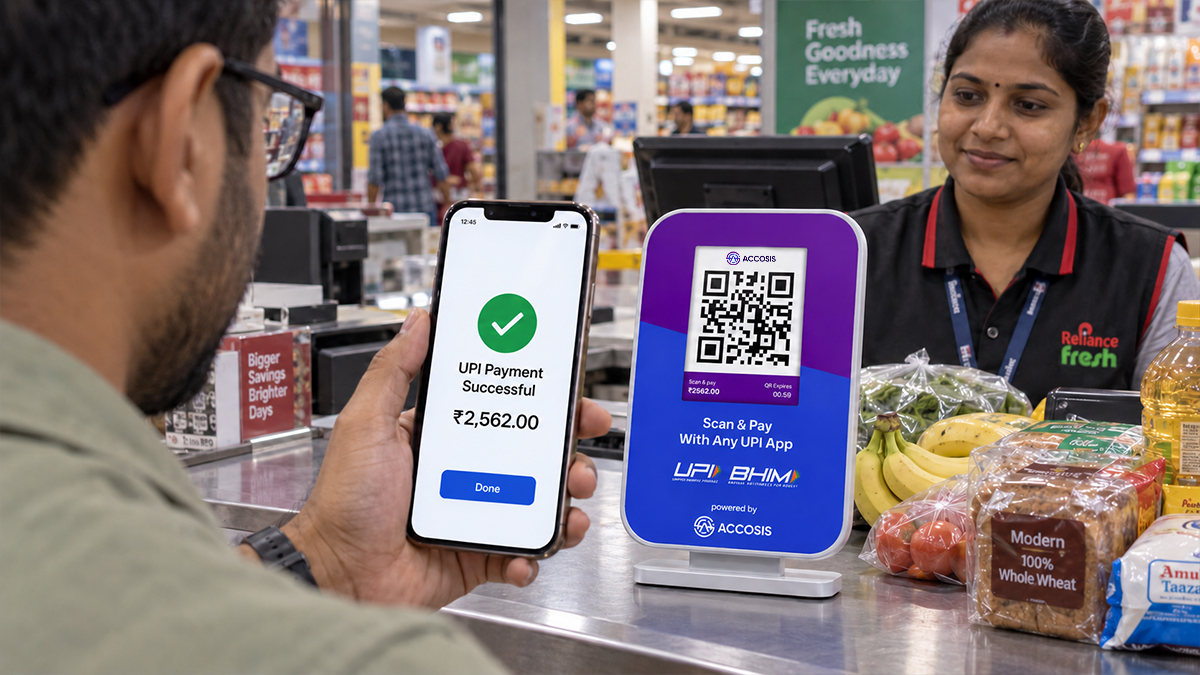
The FAQ says existing QR infrastructure continues to work. Merchants do not need to replace QR stands solely because of this framework.
Planning your payment operations with Accosis
Preparing for the new UPI MDR rules? Talk to Accosis about your payment acceptance, merchant classification and reconciliation requirements. Start with a clear view of your transaction mix and the pricing confirmed by your acquiring partner.