




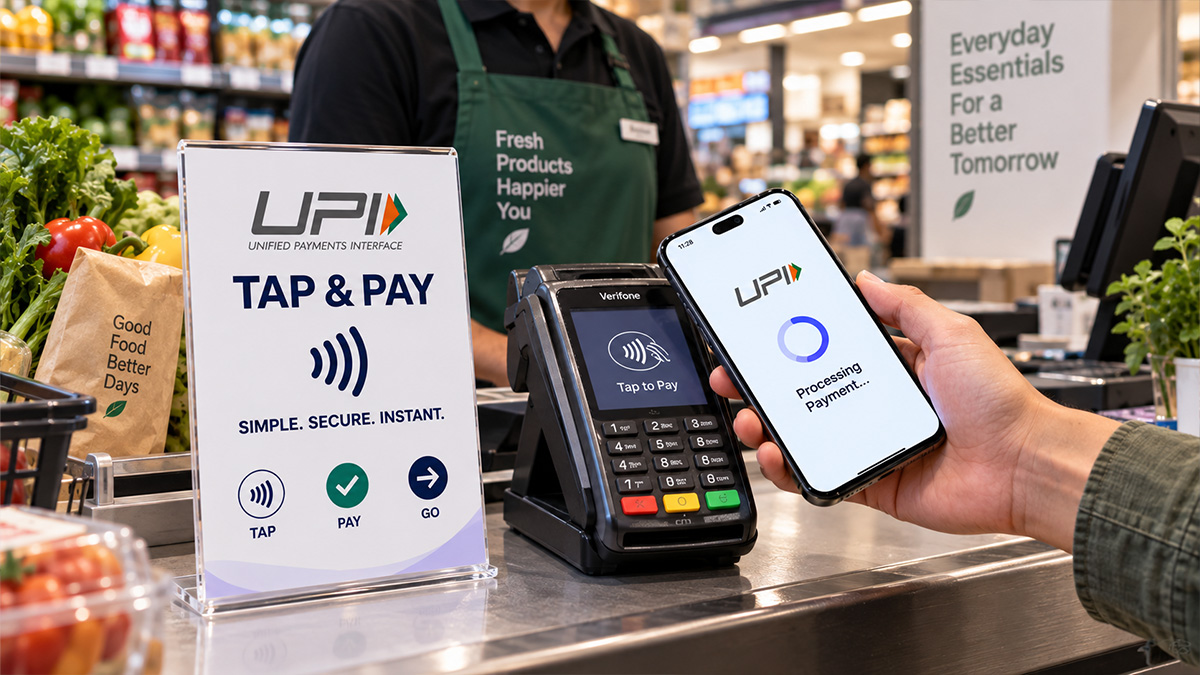
Paying through UPI at a store could soon become as simple as unlocking your phone and tapping it on a payment terminal — even when your phone has no mobile internet.
The National Payments Corporation of India (NPCI) has introduced UPI Tap & Pay, a contactless payment experience that enables users with NFC-enabled smartphones to make UPI payments at compatible NFC-enabled Point-of-Sale (POS) terminals.
The feature was unveiled by Reserve Bank of India Governor Sanjay Malhotra on September 10, 2026, at the Global Fintech Fest 2026 in Mumbai.
What makes the feature particularly interesting is that the customer’s smartphone does not need an active mobile-data or Wi-Fi connection to complete the payment.
Instead, the transaction can use the internet connection available on the merchant’s POS terminal.
No Mobile Internet? You Can Still Pay
Think about a familiar situation.
You are standing at a billing counter. Your mobile network is weak, mobile data is not working, or your phone cannot establish a reliable internet connection.
Normally, this can interrupt a UPI payment before it even begins.
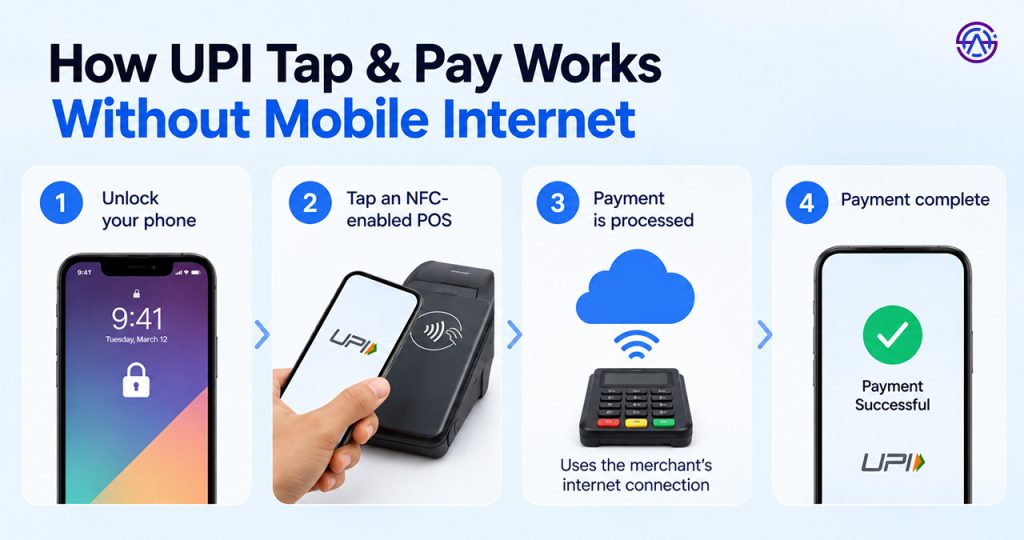
If the smartphone supports Near Field Communication (NFC) and the merchant has a compatible NFC-enabled POS terminal, the user can simply:
Unlock the phone → Tap the POS terminal → Complete the payment
There is no need to depend on the customer’s mobile-data connection for the transaction to be processed.
The POS terminal uses its own internet connectivity to communicate with the payment network.

How Does UPI Tap & Pay Work Without Mobile Internet?
The technology behind the tap is NFC, or Near Field Communication.
NFC allows compatible devices placed very close to each other to communicate wirelessly.
In this payment flow, the customer brings an NFC-enabled smartphone close to a compatible NFC-enabled POS terminal.
The tap initiates the payment interaction between the two devices.
The important difference is where the network connection comes from.
Customer’s phone: Mobile internet is not required
Merchant POS terminal: Internet connectivity is required
Connection between phone and POS: NFC
This distinction is important.
UPI Tap & Pay should not be confused with a completely internet-free payment system where neither device requires connectivity.
Payments Up to ₹5,000 Without UPI PIN
NPCI has also simplified the experience for smaller payments.
Users can make eligible UPI Tap & Pay transactions of up to ₹5,000 without entering a UPI PIN, according to reports on the announcement.
For payments above ₹5,000, additional PIN authentication is required.
This makes the payment journey considerably shorter for everyday transactions.
Instead of:
Open app → Scan QR → Wait for network → Enter amount → Enter UPI PIN → Pay
the new experience can become:
Unlock → Tap → Pay
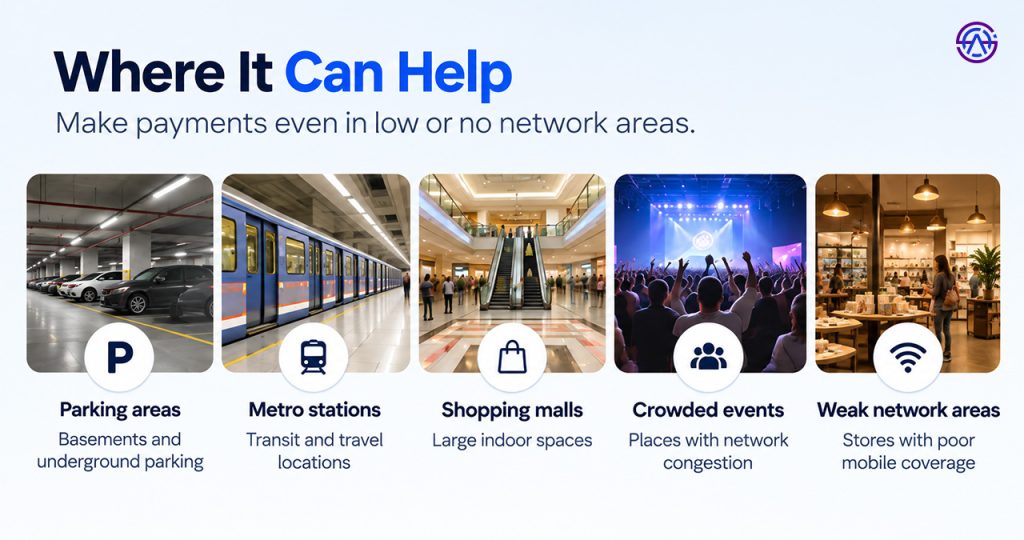
Where Could Payments Without Mobile Internet Be Useful?
The feature could be particularly useful in locations where customers frequently experience unstable mobile connectivity.
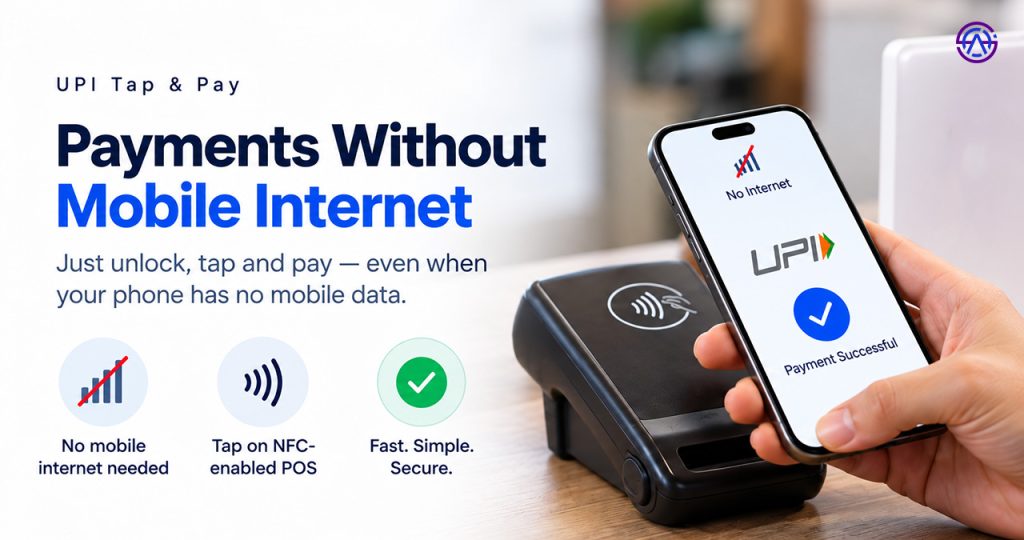
A customer may have a perfectly functional bank account and UPI setup, but a weak mobile-data connection can still delay the payment experience.
By shifting the connectivity requirement from the customer’s phone to the POS terminal, UPI Tap & Pay can reduce that dependency.
What Do You Need to Use It?
Not every smartphone or payment terminal will automatically support UPI Tap & Pay.
For the experience to work, the payment setup needs to be compatible.
An NFC-enabled smartphone
The customer’s device must support NFC technology.
A supported UPI payment setup
Support will depend on participating banks, UPI applications and payment providers as the capability becomes available to users.
A compatible NFC-enabled POS terminal
The merchant’s POS terminal must support the new Tap & Pay experience.
POS internet connectivity
Although the customer’s phone does not require mobile internet, the newly announced payment flow relies on the POS terminal’s connectivity to process the transaction.
At launch, Deccan Founders reported support from 32 banks, 15 UPI apps, eight acquirers and aggregators, and 18 payment service providers.
Does It Work in Airplane Mode?
Coverage of the launch specifically notes use in low- or no-network conditions on the customer’s smartphone, including scenarios where mobile connectivity is unavailable.
However, the important requirement remains the same:
The compatible POS terminal must have the connectivity required to process the transaction.
So, rather than thinking of the feature as completely “offline UPI,” a more accurate description is:
UPI payment without mobile internet on the customer’s phone.
Why Is This Important?
Mobile connectivity has always been one of the practical dependencies of digital payments.
Even in cities with strong network coverage, indoor environments, crowded locations and network congestion can sometimes make a simple payment take longer than expected.
UPI Tap & Pay changes where that connectivity dependency sits.
For customers, that means fewer situations where a payment is delayed simply because their phone cannot get a reliable network connection.
And because NFC only requires the user to bring the phone close to the terminal, the experience becomes closer to the familiar contactless-card interaction.
From Scan & Pay to Tap & Pay
QR codes made UPI payments simple:
Scan. Enter. Pay.
UPI Tap & Pay takes another step toward making physical-store payments even more effortless:
Unlock. Tap. Pay.
The most important change isn’t simply replacing a QR scan with a tap.
It is making the customer’s mobile internet connection less critical at the exact moment a payment needs to happen.
For millions of everyday transactions at physical stores, that small change could make the checkout experience significantly smoother.
As digital payments continue to evolve, the best payment experience may increasingly be the one customers barely have to think about.
No mobile internet on your phone. No QR scan. Just tap and pay.


